Beyond Silence:
Decoding the Inner World of Afaf Zurayk
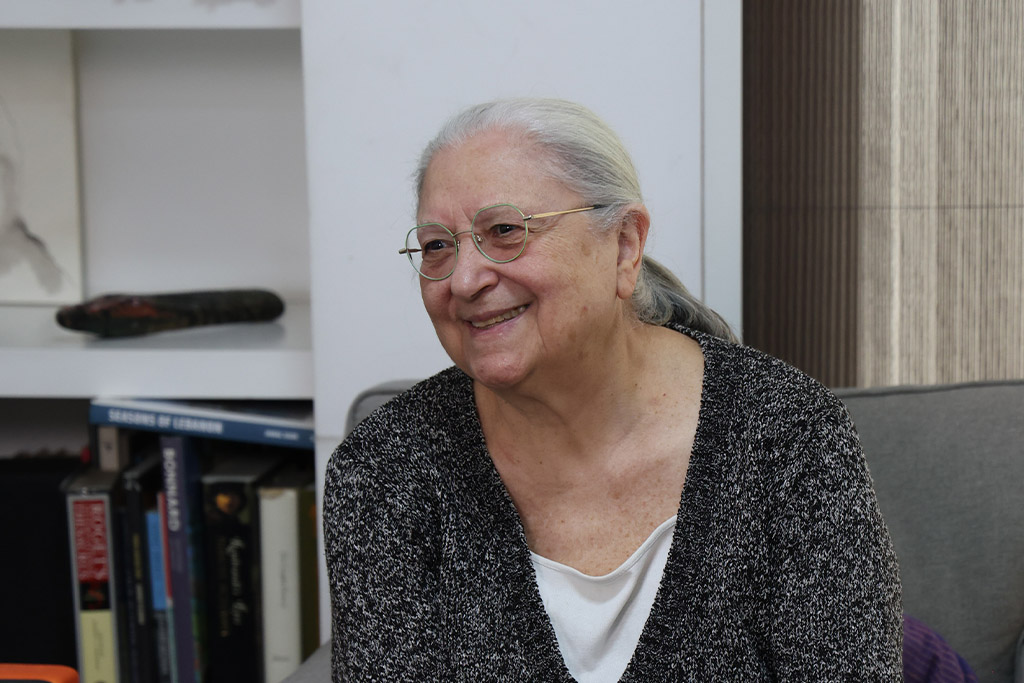
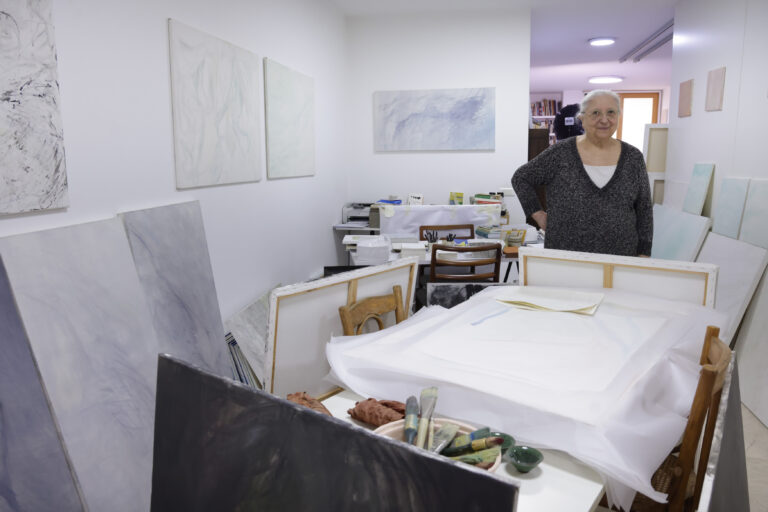
There must be something more than silence, both in multifaceted artist Afaf Zurayk’s inner world and in her minimalist works, which find their way to anyone standing before them as hidden, subliminal messages.
Hiding love. This persistent need to use kindness—even in its highest form of restraint and what looks like order—to communicate with a world to which she does not necessarily belong. Even when her small, kind smile and soft voice succeed in convincing you that, in fact, she considers herself one with it.
A love so great, it can only be met with silence and tears. Silence. There goes that word again. And it is a huge endeavor to seduce this extraordinary artist away from this vast ocean of silence in which she lives. Decades of stillness, academic work, static forms that conceal within them dozens of layers, and subdued words that embrace the nakedness of feelings—once you learn how to decipher them.
“Does this world really understand all the riches and eruptions of emotions lurking behind the polite smile, the excruciating silence of her paintings, and the cautious words used to portray the greatest of love in her poems?“
The Nostalgia of Ras Beirut
She cannot estimate how much time Ras Beirut needs to become another world, another country, another haven. What is the time frame between one coup and another? Perhaps, the change inevitably occurs, as she confesses, whenever she herself changes.
She finds it a dynamic place. Her memories there never fade. She remembers her childhood, not always relying on the bus to go to school at Al Ahlyia. Walking from Makdessi Street to Wady Abou Jmeel was the epitome of normalcy. The cotton candy (ghazel el banat) bought on the way. Frolicking amidst the sands covering the very safe streets. She must have been five. Maybe six. They were, as she almost wistfully describes, a beautiful community. The parents felt safe sending their children out into the streets of a place that never remains the same.
And then life happened. And everything changed. Beirut, as she murmurs, grew older. “Exactly like us. As we all did,” and on the way to adulthood and beyond, “we all became complex one way or another.”
The Discovery of Nuance
Her parents discovered, as she turned ten, that there was something different about Afaf. Something related, in more ways than one, to the arts in all their forms. They sent her to the Sami Salibi School of Arts. She enrolled in many courses. She drew all the time.
She loved charcoal. She is not sure if she had a style back in elementary school, but charcoal, she loved! She created nuances out of it. Rubbing it on her fingers until they became dirtier. Dirtier still. She would wipe it long enough to watch a light emanate from it. She would then notice the darker parts.
When she grew older, she chose oil colors. Once again, she would catch glimpses of the nuances emerging from different angles. Those nuances would later shape her career. Or rather, her inner journey finding its way to the outside world. Recognizing her brilliance, her parents asked pioneer artist and critic Helen El Khal to give her private lessons.
The University Years: Bliss Street and Beyond
Initially accepted into the School of Architecture for her brilliance in geometry, she quickly realized she was too emotional for such a structured world. She transitioned into the Fine Arts School at AUB, where Helen El Khal taught.
Her memories of that department, of that Ras Beirut, were lovely. She entered AUB in the fall of 1967, straight after the Six-Day War. At the time, there were student revolts in Columbia and Paris, the Vietnam War, the Rolling Stones, the hippies. “It was lovely,” she almost laughs. “A strange mix. Some students were very politically involved… We had every kind of person at the University. From Pakistan, Afghanistan, the United States, France, and Iran. It was a fabulous place to be.”
Ras Beirut wore the regal robe of Bliss Street. The restaurants scattered along its pavements: Faysal restaurant, Uncle Sam, Khayyat Bookstore, Librairie Du Liban. Jeanne D’Arc Street was lined with bookstores. The cultural movement was a sight to behold.
When she graduated from AUB with her BA in Fine Arts, her confidence was shattered. Feeling she lacked the right caliber to be an artist, she pivoted. “So I said: let me go study Art History… if not as [an artist], I could become a scholar.” She was accepted at Harvard to study Islamic Art History at age 20. But she immediately knew: “I really was not a scholar. I am too emotional. Too volatile.”
“I saw my whole life crumbling down. I locked myself in my bedroom every afternoon and I started painting watercolors. That was it. I picked up the brush and I never let it down.”
War, Watercolors, and Awakening
From the ages of 22 until 27, she experimented with many different fields in order to run away. She became the director of al-Ahlyia School, later teaching Art History and Drawing at BUC (now LAU), and was appointed director of student activities. She was geared to become an academician and administrator.
Then, the war interfered.
“I was very, very affected. The only way I could understand all that was happening to me personally, and everything around me, was to paint. I saw my whole life crumbling down. I locked myself in my bedroom every afternoon and I started painting watercolors. That was it. I picked up the brush and I never let it down – that was in 1976 or 1978. Then and there, the choice was made.” Poetry, just as capable of suppressing volatile emotions as the paintbrush, came a little later.
Deciphering the Light
Patron of the Arts and gallerist Saleh Barakat understood her love, kindness, and quest for connection in an empty world. They could both read the nuances Zurayk was so attached to. He saw endless stories amidst the layers of white and pale forms on her canvas. He quickly learned that for her, there is always a fine line between light and darkness. It is all a play of nuances. Subtleties will show you the way, if you are courageous enough to be led into this silent world.
“There is always a fine line between Light and Darkness. It is all a play of nuances. Subtleties will show you the way, if you are courageous enough to be led into this silent world.”
— Saleh Barakat
A Decade of Loss and Conversations in Clay
She still doubts herself. Her friends laugh every time she screams, “This is it! My last work. I am ready to sit back.” They nod in endearing sarcasm. She will never sit back.
Then, her father, the prominent thinker Constantine Zurayk, passed away in the year 2000. Her sister followed in 2001. Her mother, the pillar of this extraordinary family, died in 2008.
A decade of loss. The passing of her mother forced her into the quiet, polite truth that she was now left alone in this world with which she forever chose kindness to communicate. At that time, she felt the need to speak to her father. Through clay.
Shapes of clay. Music in the background. Family pictures never forgotten. Small sculptures were born during a period of six to seven months. She allowed her fingers to write the story of love for a father she hardly ever spoke with while he was alive. And yet, by the end of this series: “I felt that my father and I communicated. I talked to him.”
Trusting the Unfolding
“We cannot understand everything in this world,” Zurayk whispers. “You must simply trust. Trusting in the world. Trust in whatever moves this world. You must trust it. We are part of it. We are part of its unfolding. That’s all.”
She does not care about fighting, battling, or proving her worth. She loves solitude. She seeks it. “That does not mean I shun real life. It is very real, what I live. More so than the everyday life people actually live.”
You will never see her working in an office from 8 to 5. She owns no TV set. She does not follow the news. Everything she needs emanates from within her.
You see, it is rather an extraordinary world.